Kate's Queen City Notes

Blundering through Cincinnati, laughing all the way


Leave a comment

Pressure Canning: Shit Just Got Real

I have been canning for a few years. I knew this day would come. I bought a pressure canner. Pumpkin is what sealed this deal. Stocks and meats just don’t excite me like pumpkin. When faced with the possibility of using that sad, metallic-tasting paste that comes out of a can for another year, I went to the internets in search of pressure canners.

The first thing you should know about this canner is that it looks like it is not to be trifled with. The second thing you should know is that after perusing the directions I became anxious that I could literally cause an explosion in my kitchen. Looks, in this case, were not deceiving.
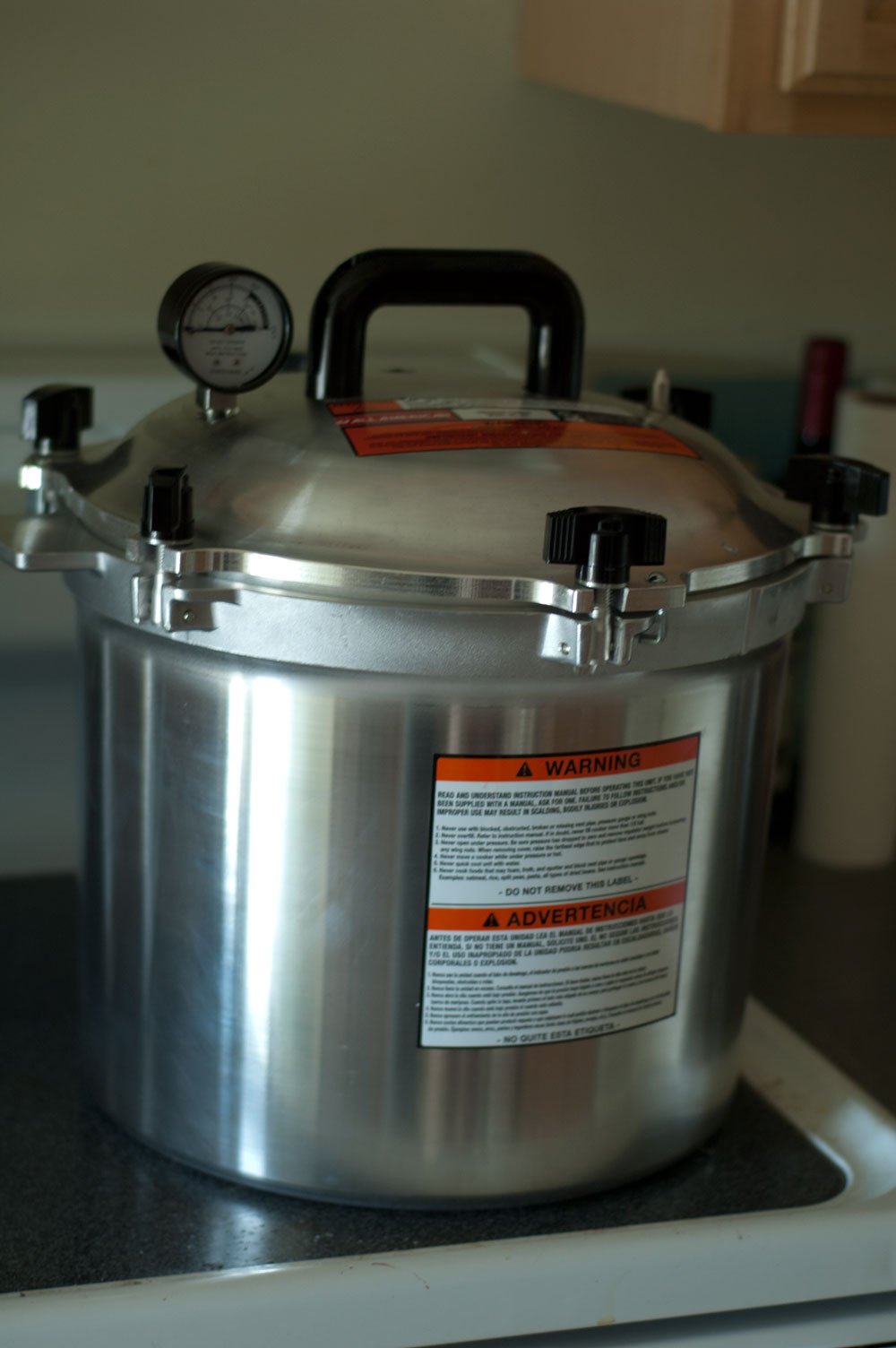
Pressure Canner

THE BEAST!

This was our most ambitious canning session to date. We planned to can a couple of varieties of apple sauce, apple butter, pumpkin butter, and pumpkin cubes. Note that we chose to can cubes because it’s not advisable to can pumpkin puree at home. The cubes will just need to be run through my food processor before they are added to my favorite recipes.

We started off with a half bushel of apples and nine pumpkins. Here’s the recipes/instructions for what we did.
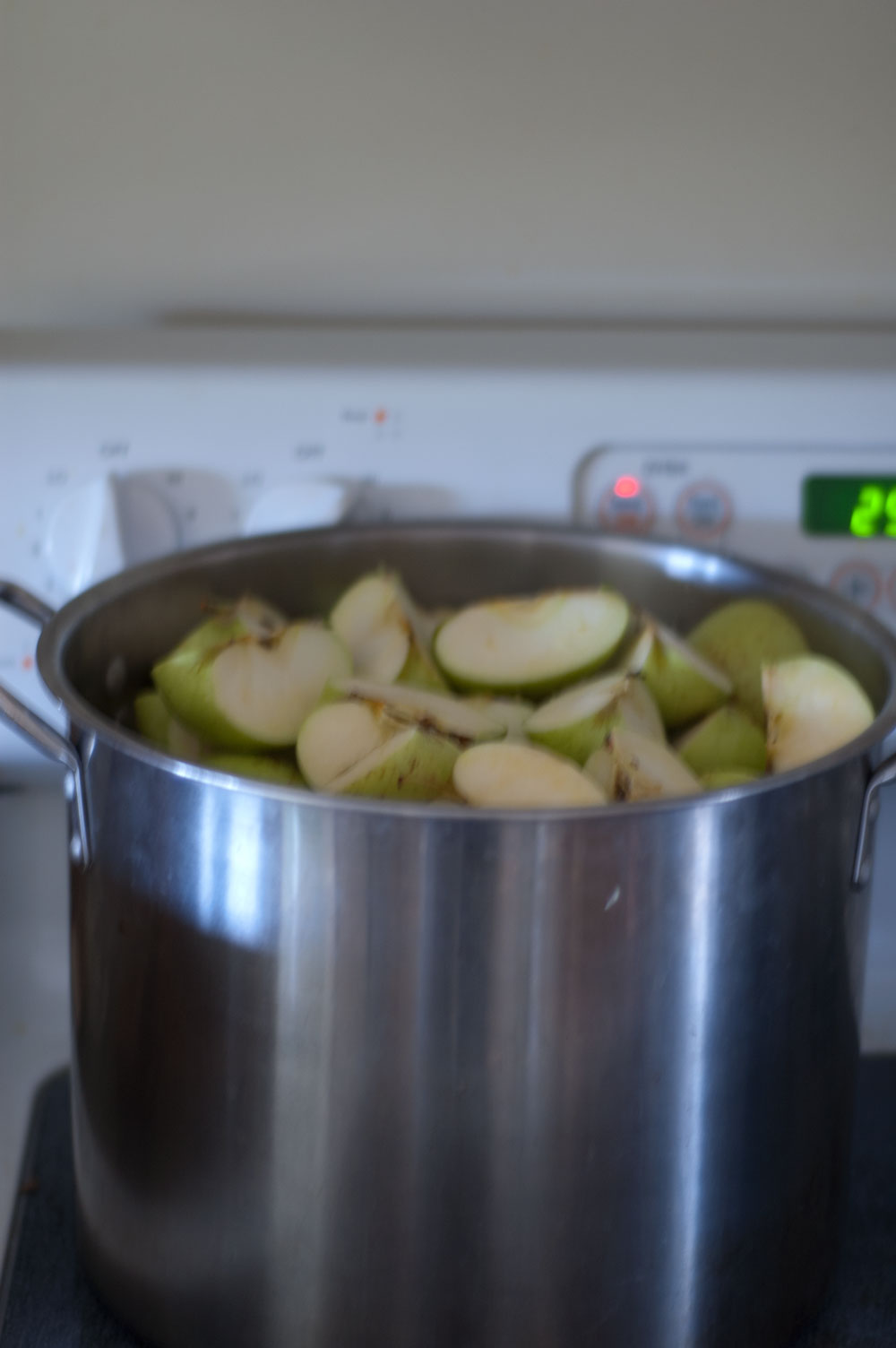
Big pot of apples.

Here’s the apples when we were cooking them down. After this we put the apples through a food mill. We brought the resulting sauce back to boiling before canning it.

Here's the apples after we processed about half of them.
Here’s the apples after we processed about half of them.

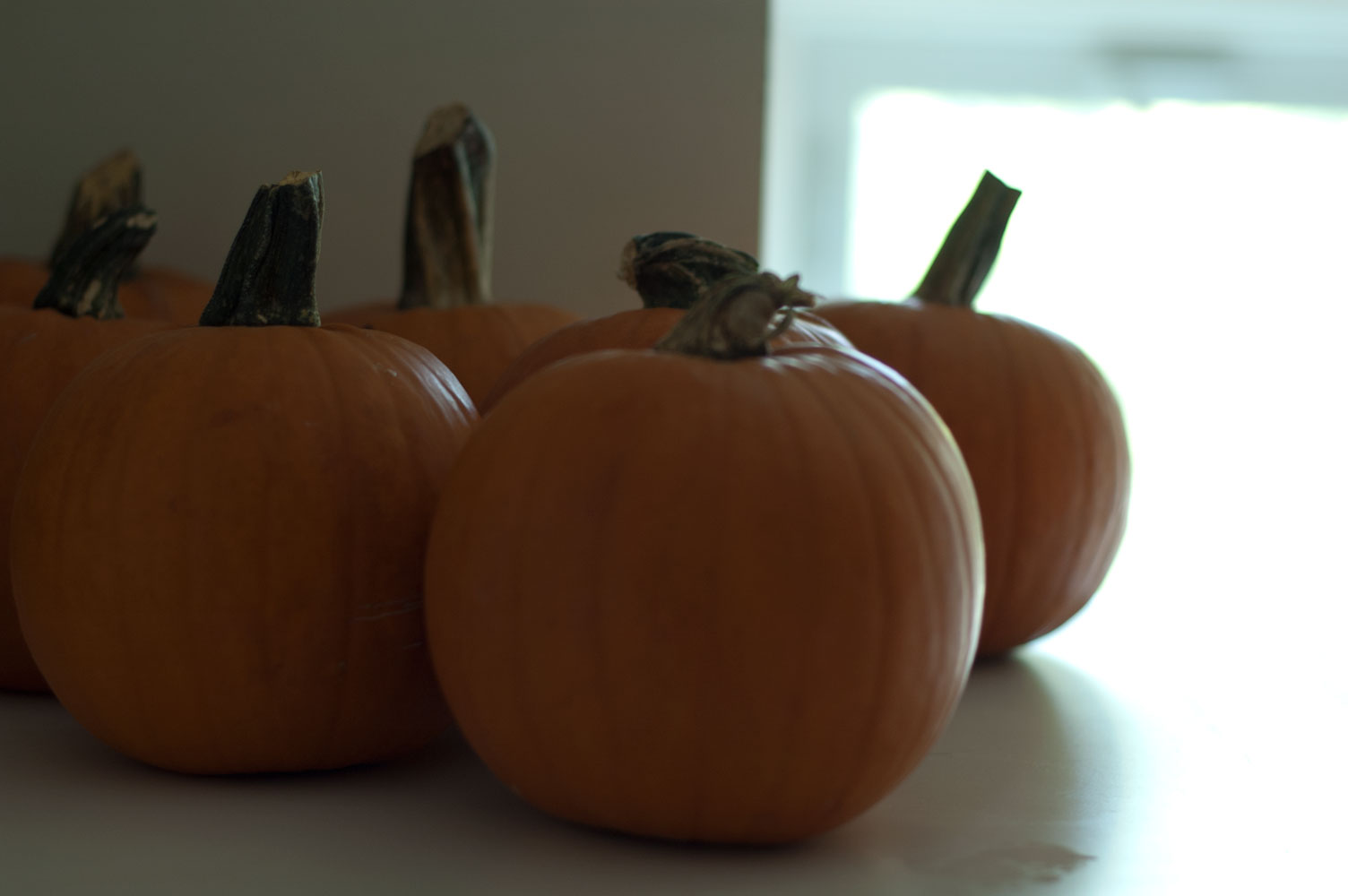
These pumpkins looked amazing.

These pumpkins looked amazing.

Pumpkin cubes: http://edis.ifas.ufl.edu/he266

Apple sauce: http://www.freshpreserving.com/recipe.aspx?r=126 (we made half the batch plain as instructed here except with less sugar. We got golden delicious apples, and they were pretty sweet without the sugar. We made the other half the batch with cinnamon and vanilla bean w/ seeds.

Apple butter: http://www.canningacrossamerica.com/recipes/apple-butter/

Pumpkin butter: http://allrecipes.com/recipe/pumpkin-butter/

Here’s the random things that we learned. I think we accidentally put 2 tsps of nutmeg in the pumpkin butter as opposed to the 1 tsp that the recipe called for. Two tsps is great if you want the nutmeg to overwhelm all the other flavors including the pumpkin. (FAIL) The pumpkin butter thickened really quickly on the stove. I don’t think we cooked it for more than 20 minutes, and in that time the concoction got much darker and thicker.

Finished jars of apple butter.
Finished jars of apple butter.

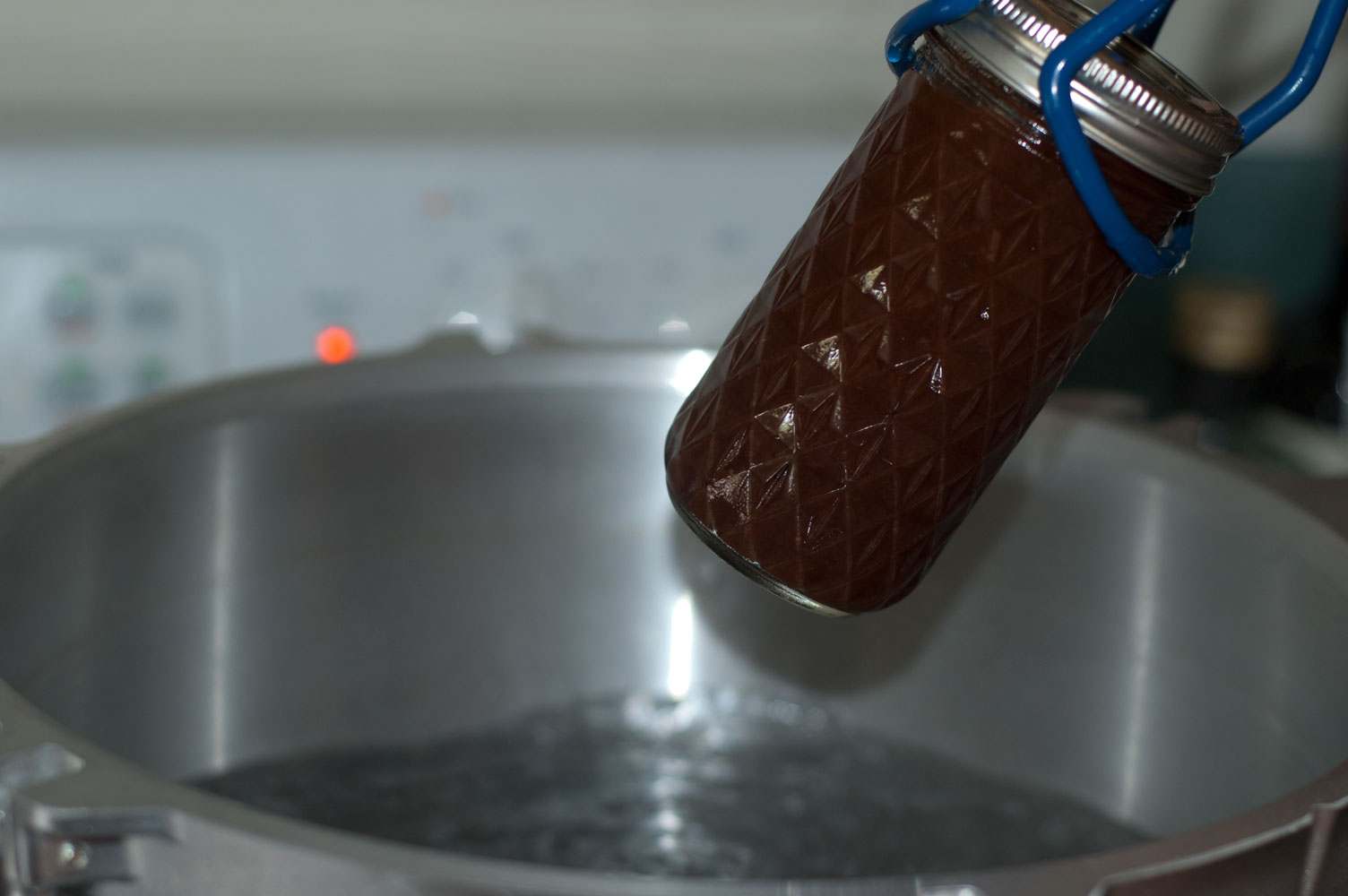
Here's a jar of apple butter coming out of the pot after processing.

Here’s a jar of apple butter coming out of the pot after processing.

The apple sauce was excellent. It was so excellent that we needed to stop ourselves from eating it before it made to the jars. If we do another fall canning session, it will be to do more apple sauce.

The pumpkin that we canned bears almost no resemblance to what comes out of store-bought cans. The color is a bright yellow and the flavor is closer to acorn or butternut squash. This made me wonder what they do to the pumpkin to get it that color and to get that mealy flavor. I don’t know if you have ever eaten a spoonful of pumpkin from the can, but it has that non-taste that commercial baby food often has. The pumpkin that we put in the jars had this slightly sweet, creamy flavor.

Image

I mentioned in a past blog that I get my produce for canning at the Lunken Airport farmers market (if you aren’t from Cincinnati just ignore that last sentence). The people who go there aren’t wholesalers; they are the actual farmers. For what they may lack in customer service skills, they more than make up for it with knowledge about the produce. The old curmudgeon farmer that I work with most often, while doubtful of my intentions at first, has now warmed to my tattooed self. It seems like I keep clearing hurdles with him. On my pumpkin purchase, he seemed pleased that I recognized the pie pumpkins from the mess of decorative gourds and pumpkins.

While we were bagging up my pumpkins he pointed to a huge green and white mottled gourd. He asked if I had ever made pie with one of those. I said no, because I had never seen this type of gourd before. He pushed his vintage (NOT RETRO) John Deere hat further back on his head and said, “Once you make pie with one of those, you’ll never want a pumpkin again.” I have heard of a gourd that is fabled to be more tasty than pumpkin. I’m pretty sure curmudgeon farmer just pointed out my gourd Moby Dick. Needless to say I will be going back next week to get one of those gourds. Be on the look out for the Moby Dick gourd blog post next week.

Leave a comment

100 Books by 40: A Prayer for Owen Meany

I finished 100 Years of Solitude and A Prayer for Owen Meany. Books that have an abundance of quirky characters annoy me. The last book that I read that had obnoxious, quirky characters was Captain Corelli’s Mandolin. Here’s what Captain Corelli’s Mandolin had going for it that 100 Years of Solitude did not, a good story. 100 Years of Solitude gets the dubious distinction of being the only book that I’ve read on the 100 best books list that I disliked enough to want to put down.

On top of my displeasure with 100 Years of Solitude, I am reading Middlemarch. My god, that book is so very long. It’s good, but I can’t shake the feeling that I will be reading it until winter. This is the context in which I read A Prayer for Owen Meany.

“…but every study of the gods, of everyone’s gods, is a revelation of vengeance toward the innocent.” – From A Prayer for Owen Meany

The book is set in 50’s-60’s New Hampshire, and 80’s Toronto. I am struggling to summarize what the book is about. It’s a story of childhood friends and how they are impacted by Vietnam, with a heavy splash of religion or more specifically faith. I don’t have it in me to talk about the religious aspects of the book. I feel like that would require 500 words to dive into and adequately discuss.

Here’s what struck me about the book. John Irving is a pretty great storyteller. Authors seem to over-play their hands when foreshadowing. Irving had moments of excessive foreshadowing. For each of those moments there were nine or ten instances of relating seemingly insignificant details that many chapters later gained significance. I loved it. This was a satisfying read.

” I believe that President Reagan can say these things only because he knows that the American people will never hold him accountable for what he says; it is history that holds you accountable, and I’ve already expressed my opinion that Americans are not big on history.” – From A Prayer for Owen Meany

“Mrs. Hoyt was the first person I remember who said that to criticize a specific American president was not anti-American; that to criticize a specific American policy was not anti-patriotic; and that to disapprove of our involvement in a particular was against the communists was not the same as taking the communists’ side. But these distinctions were lost on most of the citizens of Gravesend; they are lost on many of my former fellow Americans today.”  – From A Prayer for Owen Meany

Here’s an update on my reading list.
Reading now:
27. Middlemarch, George Eliot
33. The Pillars Of The Earth, Ken Follett

Finished reading:

1. The Lord of the Rings, JRR Tolkien
2. Pride and Prejudice, Jane Austen
3. His Dark Materials, Philip Pullman
4. The Hitchhiker’s Guide to the Galaxy, Douglas Adams
5. Harry Potter and the Goblet of Fire, JK Rowling
6. To Kill a Mockingbird, Harper Lee
7. Winnie the Pooh, AA Milne
8. Nineteen Eighty-Four, George Orwell
9. The Lion, the Witch and the Wardrobe, CS Lewis
10. Jane Eyre, Charlotte Brontë
11. Catch-22, Joseph Heller
12. Wuthering Heights, Emily Brontë
13. Birdsong, Sebastian Faulks
14. Rebecca, Daphne du Maurier
15. The Catcher in the Rye, JD Salinger
16. The Wind in the Willows, Kenneth Grahame
17. Great Expectations, Charles Dickens
18. Little Women, Louisa May Alcott
19. Captain Corelli’s Mandolin, Louis de Bernieres
20. War and Peace, Leo Tolstoy
21. Gone with the Wind, Margaret Mitchell
22. Harry Potter And The Philosopher’s Stone, JK Rowling
23. Harry Potter And The Chamber Of Secrets, JK Rowling
24. Harry Potter And The Prisoner Of Azkaban, JK Rowling
25. The Hobbit, JRR Tolkien
26. Tess Of The D’Urbervilles, Thomas Hardy
28. A Prayer For Owen Meany, John Irving
29. The Grapes Of Wrath, John Steinbeck
30. Alice’s Adventures In Wonderland, Lewis Carroll
31. The Story Of Tracy Beaker, Jacqueline Wilson
32. One Hundred Years Of Solitude, Gabriel García Márquez
42. Watership Down, Richard Adams
43. The Great Gatsby, F Scott Fitzgerald
46. Animal Farm, George Orwell
53. The Stand, Stephen King
60. Crime And Punishment, Fyodor Dostoyevsky
63. A Tale Of Two Cities, Charles Dickens *I read this when I was too young to appreciate it; I would like to read it again as an adult. I will do so if I have time.
70. Lord Of The Flies, William Golding *I’ve read this twice. I will read it again if I have time.
87. Brave New World, Aldous Huxley
90. On The Road, Jack Kerouac *I’ve read this twice. I will read it again if I have time. I have the unabriged unedited version and will probably take on that if time allows.

Pending reading:
34. David Copperfield, Charles Dickens
35. Charlie And The Chocolate Factory, Roald Dahl
36. Treasure Island, Robert Louis Stevenson
37. A Town Like Alice, Nevil Shute
38. Persuasion, Jane Austen
39. Dune, Frank Herbert
40. Emma, Jane Austen
41. Anne Of Green Gables, LM Montgomery
44. The Count Of Monte Cristo, Alexandre Dumas
45. Brideshead Revisited, Evelyn Waugh
47. A Christmas Carol, Charles Dickens
48. Far From The Madding Crowd, Thomas Hardy
49. Goodnight Mister Tom, Michelle Magorian
50. The Shell Seekers, Rosamunde Pilcher
51. The Secret Garden, Frances Hodgson Burnett
52. Of Mice And Men, John Steinbeck
54. Anna Karenina, Leo Tolstoy
55. A Suitable Boy, Vikram Seth
56. The BFG, Roald Dahl
57. Swallows And Amazons, Arthur Ransome
58. Black Beauty, Anna Sewell
59. Artemis Fowl, Eoin Colfer
61. Noughts And Crosses, Malorie Blackman
62. Memoirs Of A Geisha, Arthur Golden
64. The Thorn Birds, Colleen McCollough
65. Mort, Terry Pratchett
66. The Magic Faraway Tree, Enid Blyton
67. The Magus, John Fowles
68. Good Omens, Terry Pratchett and Neil Gaiman
69. Guards! Guards!, Terry Pratchett
71. Perfume, Patrick Süskind
72. The Ragged Trousered Philanthropists, Robert Tressell
73. Night Watch, Terry Pratchett
74. Matilda, Roald Dahl
75. Bridget Jones’s Diary, Helen Fielding
76. The Secret History, Donna Tartt
77. The Woman In White, Wilkie Collins
78. Ulysses, James Joyce
79. Bleak House, Charles Dickens
80. Double Act, Jacqueline Wilson
81. The Twits, Roald Dahl
82. I Capture The Castle, Dodie Smith
83. Holes, Louis Sachar
84. Gormenghast, Mervyn Peake
85. The God Of Small Things, Arundhati Roy
86. Vicky Angel, Jacqueline Wilson
88. Cold Comfort Farm, Stella Gibbons
89. Magician, Raymond E Feist
91. The Godfather, Mario Puzo
92. The Clan Of The Cave Bear, Jean M Auel
93. The Colour Of Magic, Terry Pratchett
94. The Alchemist, Paulo Coelho
95. Katherine, Anya Seton
96. Kane And Abel, Jeffrey Archer
97. Love In The Time Of Cholera, Gabriel García Márquez
98. Girls In Love, Jacqueline Wilson
99. The Princess Diaries, Meg Cabot
100. Midnight’s Children, Salman Rushdie


Leave a comment

Canning Tomatoes and Old Curmudgeons

I am not wholly convinced that the plastic that lines tomato cans will kill me, but why take chances when I like canning? We did two rounds of tomato canning. We canned Brandywine and other heirloom varieties in round one. We canned standard  non-heirloom tomatoes in round two. Below I will summarize how we did it.

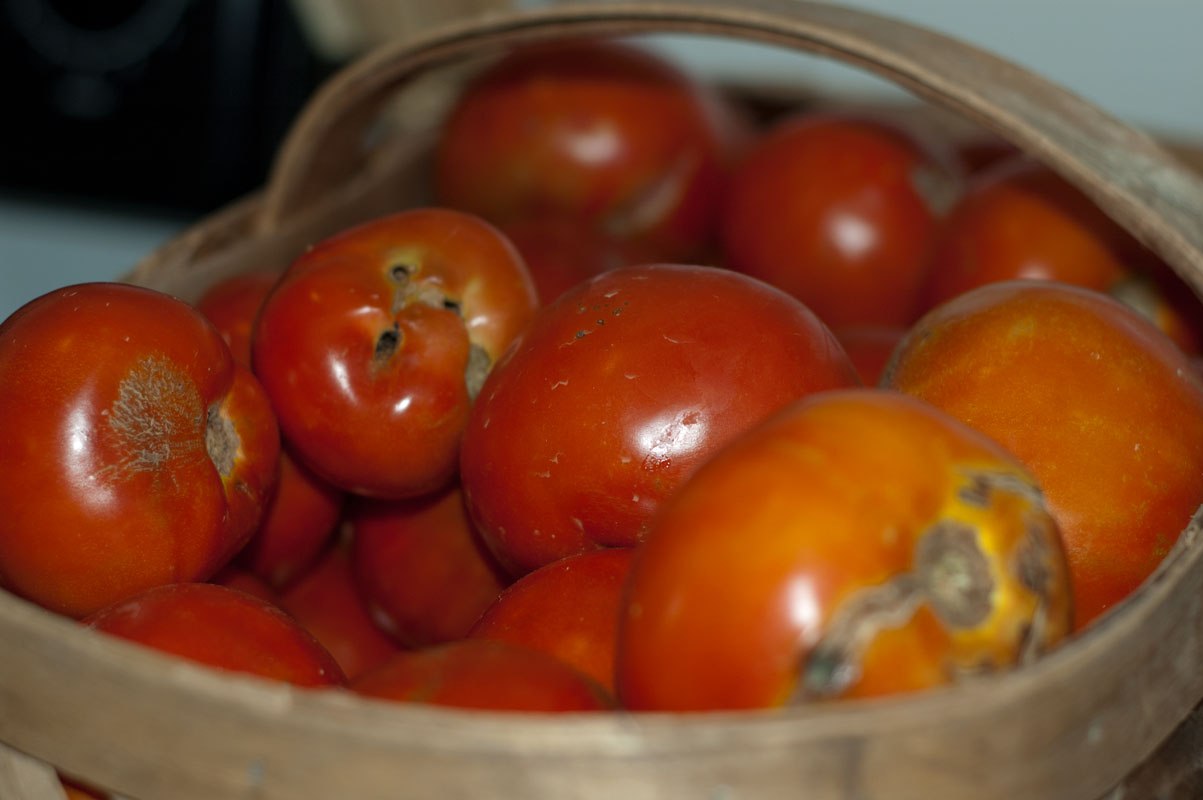
Toms

Tomatoes from the old curmudgeon farmer.

Here’s what we used

Salt

Lemon juice (for the citric acid)

Very hot water

Tomatoes

3 cases of 1 1/2 pint wide-mouth ball jars

Thyme

Rosemary

Oregano

Curry spices

Crushed garlic cloves

Herbs

Here’s the herbs we used. They were gathered from my friend’s garden.

Like my peach canning blog, I will break this blog up into 4 functional groups. Bear in mind that at any given point in the canning process we probably had jars in all functional states.

Sanitizing the Jars

The first step in the process is making sure your jars are sanitary and ready for fruit. In our past jamming sessions we let the jars boil in water for several minutes to kill the microscopic critters. After some internet searching, we found that you can also put the glass jars in the oven for 20 minutes at 250 degrees. We used the oven technique for our tomato jars, partially because the jars a bigger would be more difficult to manage in a pot of boiling water. This also freed-up an all-important heating element on the stove. We sanitized our rings and lids in boiling water.

Processing the Tomatoes

To skin the tomatoes, we dropped them in boiling water for about 2 minutes. Then we put them in an ice bath for a minute. This allowed easy removal of the skins. This was probably the most laborious part of the process. Our tomatoes were a little large, so we quartered them to enable us to fit them in the jars.

Assembling the Jars

We put the desired herbs and spices in the jars. Then we packed the tomatoes in. We topped all the jars with one teaspoon of salt and two tablespoons of lemon juice. Then will filled the jars with boiling water leaving about a half inch breathing room at the top of each jar. We made three different varieties. We packed some with curry spices (these spices were a combo of mustard seeds, coriander seeds, cumin seeds and such that had been bloomed). We packed some with rosemary and garlic. We packed some with thyme, oregano, and garlic. We were thinking that the oregano and thyme variety would be well used in pasta sauces. The rosemary variety would be a great base for a tomato soups. They curry will be used for curry, of course.

Sealing the Jars

We put the jars in boiling water for 45 minutes. All the jars sealed perfectly.

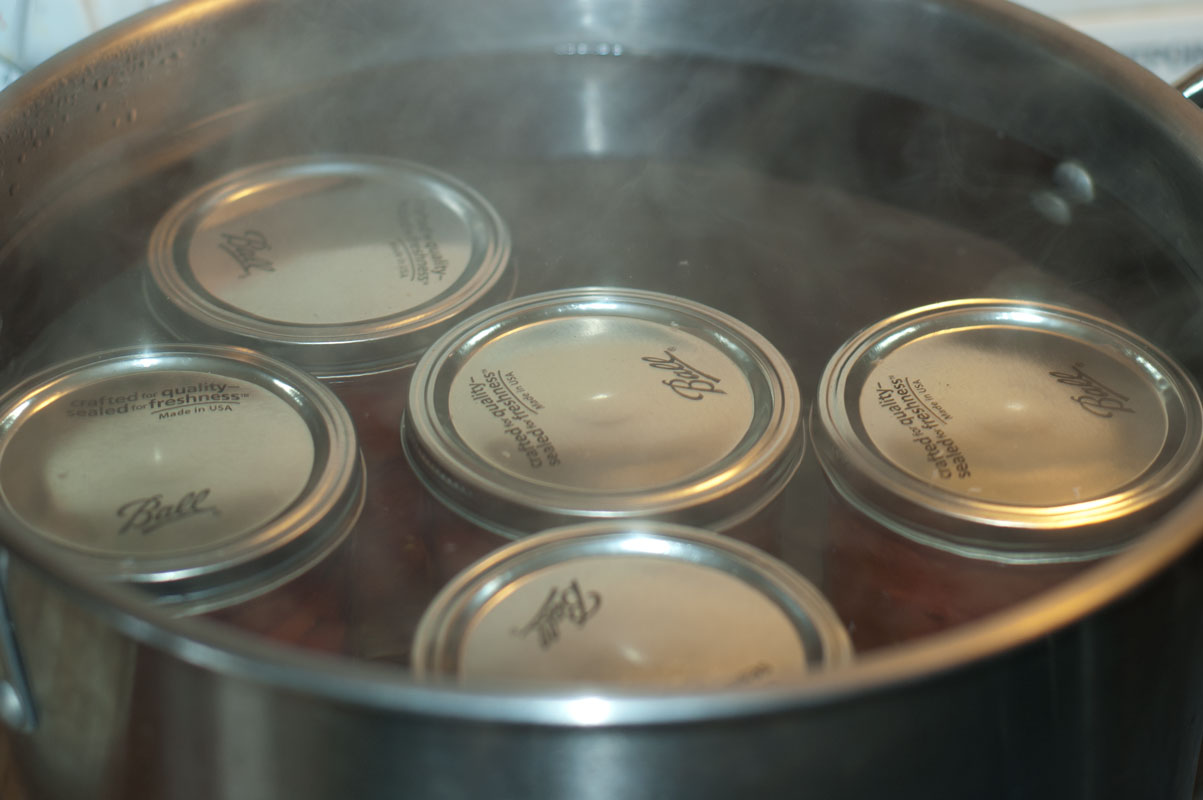
Jars

Here’s what the processing jars looked like in the pot.

A Word about Heirloom vs Plum vs Standard Tomatoes

Since we canned a few varieties, I thought I would comment on the differences between them. The standard and Plum tomatoes skinned the easiest. They were a breeze. The heirlooms were more difficult to skin and were generally more delicate to handle. They were also considerably more expensive. Unless I taste heaven in those heirloom jars when I crack them open, I won’t be canning those again. The heirlooms were about 40 bucks for roughly 10 lbs. I got lucky with the standard tomatoes. I got a tip to try the framers market at Lunken Airport (if you aren’t a Cincinnati native this will mean nothing to you). And those folks are the real deal out there. There’s a parking lot where trucks pull up; the people selling are clearly the growers. Upon my approach I was listening to a BMW driver fussing about what bag his produce is put in. Watching this guy in loafers and seersucker shorts get cranky over the size of his brown paper bag made me miss providing customer service in no way whatsoever. I approached an old curmudgeon farmer just beyond seersucker. Now reader, you should know what I look like to fully grasp the interaction to follow. I am tattooed. My hair is buzzed off into a very short mohawk. I am 37, but people seem to guess me as younger than that. I asked the farmer how much for 25lbs of tomatoes. His eyes narrowed into a hard look. After a pause that was too long for comfort, he asked what I was using them for. I said canning. Disbelief quickly followed by a little burgeoning esteem for me flashed across his face.  He leaned back and hollered to the farmer next to him. After a brief conversation he brought out a half-bushel basket of tomatoes from the truck. He had prepared the basket for someone else who failed to show. The tomatoes had minor blemishes making them perfect for canning and at a discounted price. I paid 10 bucks for 25lbs of tomatoes. AWESOME.

Walnut the cat

This is Walnut the cat. He did his best to be underfoot while we canned. He also offered unsolicited mews at regular intervals.

Finished jar

Finished jar with thyme, oregano, and garlic

I might update this blog when I sample the tomatoes that we canned. I have some recipes coming up that will cause me to crack open some jars.


Leave a comment

100 Books by 40: The Grapes of Wrath

The BBC’s 100 Best Books list (the list I am reading through) is heavy on 19th century British authors, which in turn makes the stories therein loaded with tales of 19th century England. It’s sensible that the lion’s share of English Literature would be written by English authors, and specifically not American authors. My British co-workers joke that we don’t speak English; we speak American. And I laugh and make jokes about The Queen, but I know there is truth in that statement.

While this is all very sensible, as a consequence I don’t connect deeply to these stories nor to the characters. I came to The Grapes of Wrath with the unconscious expectation to encounter another story with little bearing on my experiences. I was shocked to find that this book is about my family.

The Grapes of Wrath is set 1930’s. It describes the experiences of poor tenant farmers being driven from their barren dust bowl farm in Oklahoma to California in search of a way to make a living. The story centers around a family and their journey, all the while telling a narrative around the effects of the industrialization of food production.

And when that crop grew, and was harvested, no man had crumbled a hot clod in his fingers and let the earth sift past his fingertips. No man had touched the seed, or lusted for the growth. Men ate what they had not raised, had no connection with the bread. The land bore under iron, and under iron gradually died; for it was not loved or hated, it had no prayers or curses. – The Grapes of Wrath

The characters come alive with regional accents and colloquialisms. They are proud and hard-working. They are self-reliant and resilient in spite of the challenges they face. They are driven to desperate acts by the compulsion to survive.

There ain’t no sin and there ain’t no virtue. There’s just stuff people do. – The Grapes of Wrath

My dad was 42 when I was born, and he was the youngest of my grandmother’s nine children, which explains how so many years exist between our generations. My grandparents were poor tenant farmers in rural north east Ohio. My grandmother was 36 in 1930. They moved from one rented farm to another, only to find the house dilapidated and the land exhausted.

My grandmother used certain phrases, phrases that K-12 schooling has scrubbed out of use. Mayhaps. Mayhaps, I will go to the store. Haint so. The characters in The Grapes of Wrath are my grandmother. They are my great aunts and uncles. They are cousins and extended family. But the stories diverge. My grandparents were lucky. They would probably call it God’s will. Since they lived in Ohio, and not The Dust Bowl, they managed to get food on the table during The Depression. Through incredibly hard work they were able to feed themselves and get enough extra to keep on their land. My dad and his 8 siblings supported eachother and the family such that they all got college educations. By the time my grandmother died at 100 in 1994, she was living in a home of her own. This isn’t now The Grapes of Wrath ended.

The Grapes of Wrath is about the human toll that’s taken by the relentless progress that capitalism demands. Hordes of humans are grist for that mill. This issue is just as relevant today as it was when this book was written. In the book, migrant farm workers who balk at shrinking wages are called reds. Occupy Wall Street supporters balk at minimum wage and are called socialists. The most remarkable thing is how little has changed.

Income inequality in America. Unsustainable.

“Why, you’re Joe Davis’s boy!”
“Sure,” the driver said.
“Well, what you doing this kind of work for-against your own people?”
“Three dollars a day. I got damn sick of creeping for my dinner-and not getting it. I got a wife and kids. We got to eat. Three dollars a day, and it comes every day.”
“That’s right.” the tenant said. “But for your three dollars a day fifteen or twenty families can’t eat at all. Nearly a hundred people have to go out and wander on the roads for your three dollars a day. Is that right?” – The Grapes of Wrath


1 Comment

Adventures in Cooking: Canning Peaches

Neither of my grandmothers cooked much with processed/packaged foods; this is more to do with their age than an ideology. I canned jams and jellies with my dad’s mom until I was school-aged. I grew up eating homemade breads, jellies, jams, and assorted baked goods. It made me picky. I started making my own jams because I grew dissatisfied with store-bought. This little taste of canning made me bold.

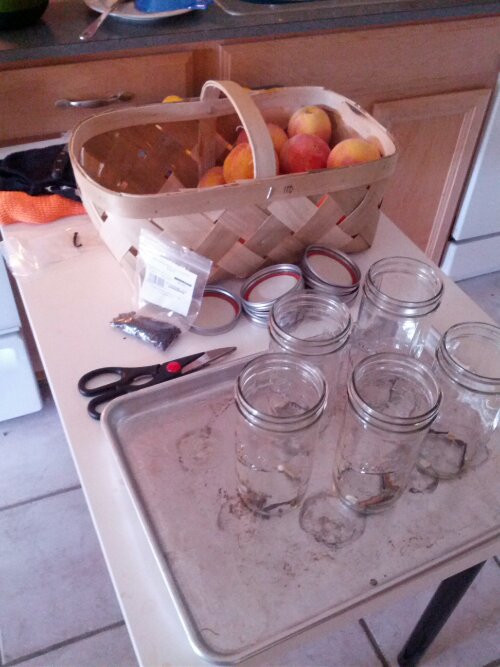
A good friend and I got a basket of South Carolina peaches, a mess of jars, and an assortment of spices. We were unsure how well any of this was going to work. Here’s what we started with.

Peaches and jars

Here’s the peaches and jars. That basket was full. We where half way done with processing them at the moment that I snapped this picture.

3-4 vanilla beans

20-20 green cardamom seed pods

15 1 inch cinnamon sticks

20-30 star anise

Several types of chai tea (this will make more sense later)

Several cups of sugar

A few tablespoons of lemon juice

A bottle of bourbon (Ancient Age)

3 cases of 1 1/2 pint wide-mouth ball jars

I’m going to break this up into 4 functional groups. Bear in mind that at any given point in the canning process we probably had jars in all functional states. This is critical to understanding how we managed to do this in about 4 hours.

Sanitizing the Jars

The first step in the process is making sure your jars are sanitary and ready for fruit. In our past jamming sessions we let the jars boil in water for several minutes to kill the microscopic critters. After some internet searching, we found that you can also put the glass jars in the oven for 20 minutes at 250 degrees. We used the oven technique for our peach jars, partially because the jars a bigger would be more difficult to manage in a pot of boiling water. This also freed-up an all-important heating element on the stove. We sanitized our rings and lids in boiling water.

Processing the Peaches

To skin the peaches, we dropped them in boiling water for about 2 minutes. Then we put them in an ice bath for a minute. This allowed easy removal of the skins. This was probably the most laborious part of the process.

Assembling the Jars

We threw the desired spices in the bottom of the jars first. We did a mix of plain vanilla, plain cinnamon, and mixed spices. The jars got roughly one quarter of a vanilla bean, a once inch cinnamon stick, a couple of slightly crushed cardamom pods, and one star anise. We hand packed the peaches in the jars over the spices. Then we poured very hot simple syrup (one quarter sugar to three quarters water) over the peaches. We added 2 tablespoons of bourbon to the jars as desired. We put Indian traditional chai tea in one of the jars, and we put green passion fruit tea in the other. Picture below.

Tea with the peaches

We aren’t sure how the peaches will do with the tea. We have already agreed that we both must be present when the peaches are sampled.

Sealing the Jars

We put the jars in boiling water for 20 minutes. About 9 out of 10 jars came out and sealed nicely. There were a handful that we need to put back in to get them to seal.

Then we waited. I didn’t wait very long. This is partially because I am impatient and partially because I wanted to taste test how we did. We had planned to do another canning session the following weekend. I wanted to know if we should make any adjustments.

I had only eaten commercially canned peaches prior to opening a jar of ours. Eating those peaches was life-altering. Not only do I not understand why no one has commercially canned peaches with some of the spices we used, but I also don’t understand why more people aren’t canning their own peaches. My god. Those were absolutely delicious. I’m ruined for peaches in heavy syrup forever. The simple syrup we used was enough to make the peaches sweet, but not overwhelming. The sugar just complements the flavor of the fruit as opposed to drowning it. I suspect one of the reasons the sweetness in our peaches wasn’t as cloying as commercially canned peaches might be that we used cane sugar as opposed to the high fructose corn syrup.

Some of my friends have offered me money for a jar of our peaches. I am typically generous with our jams. But the peaches. I don’t think I can part with the peaches. My parents will be lucky to get any of the peaches.

Update: we opened the peaches that we packed with tea. They were delicious! We ate them with some homemade vanilla custard. It was divine.


Leave a comment

100 Books by 40: The Story of Tracy Beaker

Imagine my pleasure when I picked up The Story of Tracy Beaker, and found it to me such a slim book. This is mostly owning to how long Middlemarch and The Grapes of Wrath are. I just realized a couple of weeks ago that I am running a bit behind in my goal to read 100 books by 40. In addition, I have an epic copy of The Grapes of Wrath from the Hamilton County Library. It looks like it was bound in the 60’s and was acquired from another library by Hamilton county. It is complete with multiple students notes and highlights.

The Story of Tracy Beaker is a children’s book. But the themes seem a bit heavy for kids. In all fairness, I don’t know any young adults well and can’t have a firm grasp on what they can and cannot digest. The book is written from the perspective of a ten year-old girl living in a children’s home awaiting a new foster family. She’s been bounced around to a couple of different homes, and acts out in a way that is reasonable given her history.

My epic copy of The Grapes of Wrath

My epic copy of The Grapes of Wrath and The Story of Tracy Beaker

This book was touching, and adequately described what sort of feelings kids without homes must experience. The ending was realistic and hopeful without being a storybook finish. This was a great two-hour read, and I would suggest it.


5 Comments

100 Books by 40: Tess of the d’Urbervilles: A Pure Woman Faithfully Presented

I am starting with an aside. I don’t watch much TV, outside Mad Men and Breaking Bad. I was watching Fringe. I just started back up with Dexter. I feel like I have gone from drinking a 20 dollar bottle of wine to a 50 dollar bottle of wine. Dexter is a great show. I dropped off after the Julia Stiles season; I hate her. And that season was such a disappointment after the John Lithgow season. So far Colin Hanks is a vast improvement over Stiles.

Now then Tess, this was a great book. It is set in 1870’s England. The book primarily tells the tale of what happens to women as a result of sexual indiscretion as opposed to men. Things have changed little from the time of this novel to today. Men are still easily forgiven if not encouraged to express themselves sexually, and women are still penalized. Sure the consequences have changed, but the overall practices are quite similar. Girls who claim rape are bullied on Twitter (thanks Stubenville rape case). Women who advocate for accessible birth control are called sluts (thanks Rush Limbaugh).

The author was very sympathetic to Tess. The author seems to argue that sexuality, particularly female sexuality is natural. There is one bit that I didn’t enjoy about the book, and discussing it requires a spoiler alert.

*********************SPOILER ALERT**********************************
Tess ultimately murders the man who took here virginity. There are many things that lead to this which makes the reader sympathetic to Tess’ actions. She flees with the man who she actually loves; she is apprehended while sleeping on the altar of Stonehenge. This metaphor for nature being sacrificed at the altar of convention and religion was a bit too much for me. I felt like this bit was heavy-handed. Otherwise the book was really great.


Leave a comment

100 Books by 40: The Hobbit

I finished reading The Hobbit this week. And I’m nearly done with Tess of the d’Urbervilles. I started this project 12 months ago, so this is a great time to check my progress and evaluate my reading pace as compared to my goal. If that last sentence felt controlled, you should know that I manage multi-million dollar projects for a Fortune 50 company. Charting progress against a measurable goal is like breathing to me. Sorry about it.

Now then, The Hobbit was such a pleasant romp as compared to Gone with the Wind. Unlike my sequence of book-reading vs movie-viewing for The Lord of the Rings booksI saw The Hobbit: An Unexpected Journey before I read the book. Having finished the book, I can say dividing the book into tree movies was a poor choice. The book has a nice brisk pace to it; it’s exciting to read. The first movie was a total snooze in comparison. I enjoyed this book very much. Don’t let the movie dissuade you from picking it up.

I have been reading for 12 months. With seventeen books under my belt, I have averaged 1.42 books read per month. Since I have 30 months remaining and 67 books left to read, I will need to increase my pace to 2.23 books read per month.  That’s a 36% increase. While that’s nothing to sneeze at, I did read other stuff this year. I browsed my subscriptions to the New York Times, The New Yorker, The Atlantic, The Economist. On top of that, I read I Thought It Was Just Me (but it isn’t): Making the Journey from “What Will People Think?” to “I Am Enough”, What do Women Want?,  and Quiet: The Power of Introverts in a World That Can’t Stop TalkingThese books were great for very different reasons. I didn’t write about them here, mostly because they aren’t on my list.

I am thinking that if I cut out that other reading, I should make my goals. It’s just tough to keep at that list. Most of the books are pretty tough reading and cover emotionally difficult subject matter. The Grapes of Wrath is coming up, for example. I am sure I will learn a lot from that book and value my experience reading it. But let’s be honest, if we all wanted to live in the reality of The Great Depression wouldn’t we have chosen to stay there? Exactly. I need to stop writing and read…